

What a bad hire actually costs
Most teams track cost-per-hire obsessively and never track the cost of a hire going wrong. We ran the numbers on an ordinary role. It isn't pretty.
Every company we've worked with knows its cost-per-hire to the decimal. Almost none of them can tell you what their last bad hire cost. That's odd, because the second number is usually ten times the first.
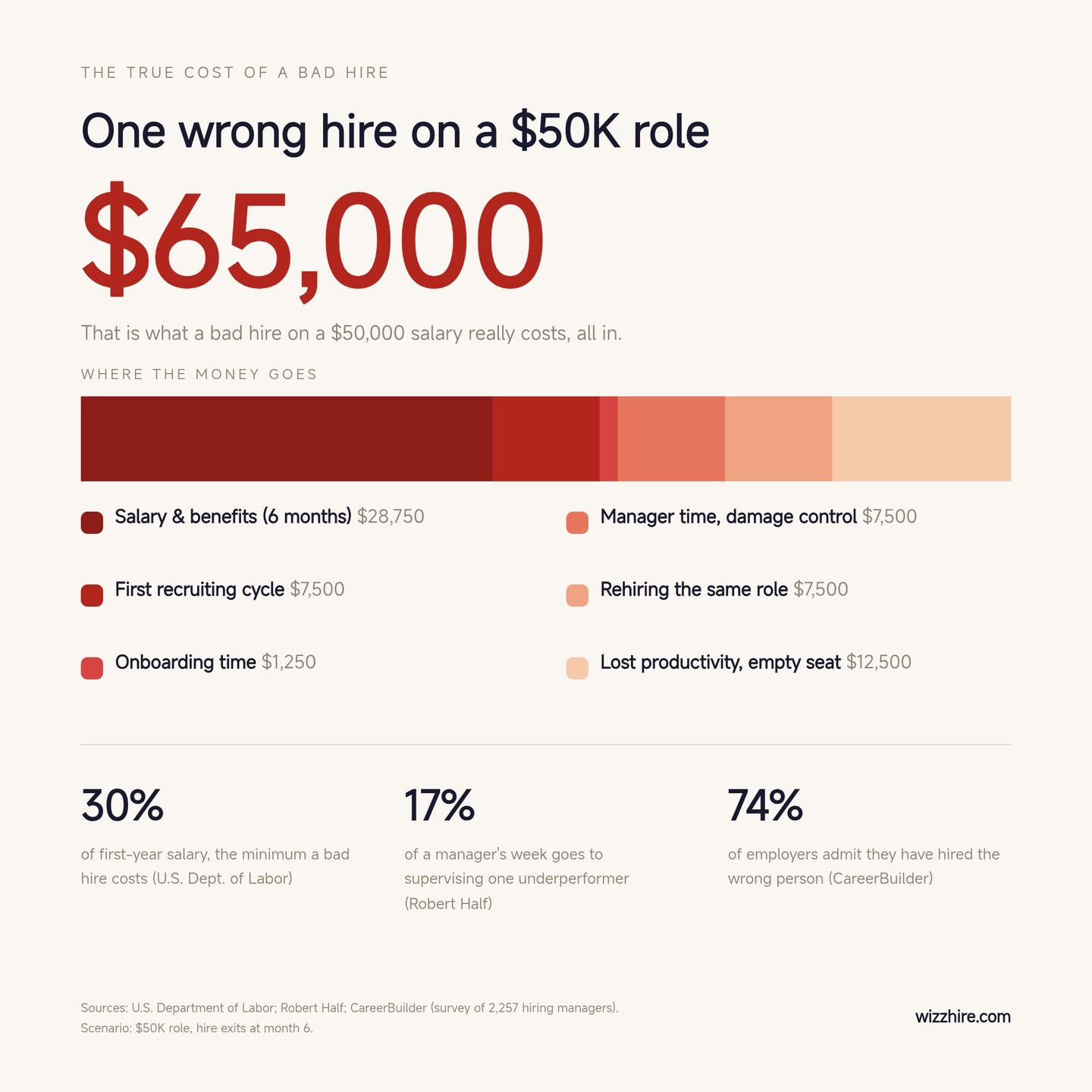
The math on one ordinary role
Take a $50K role where the hire exits at month six. Six months of salary and benefits are gone: about $28,750. The first recruiting cycle ran around $7,500, onboarding another $1,250. The manager spent roughly 17% of their week on damage control, which is what Robert Half's survey of 1,400 CFOs found managing an underperformer typically takes: nearly one full day, every week. Then you rehire the same role for another $7,500, and the seat sits empty or half-productive in between, worth another $12,500 conservatively.
Add it up: roughly $65,000. On a $50K role. And none of it appears in any report, because each cost lands in a different budget.
How often does this happen?
More often than anyone admits in a retro. 74% of employers say they've hired the wrong person (CareerBuilder, surveying 2,257 hiring managers). The U.S. Department of Labor puts the floor at 30% of first-year salary (referenced by SHRM). Our breakdown above is deliberately conservative; it ignores team morale, client impact, and the projects that quietly slip.
It gets worse when the hire isn't yours
Everything above assumes an in-house role. When the wrong person joins through team augmentation, the same math applies, plus a few multipliers: your roadmap slows while a stranger holds part of it, your team spends its own hours reviewing work they'll redo, and knowledge walks out the door at the end of the engagement. The fee you "saved" by picking fast over picking right is the smallest line in that table.
This is why vetting is the whole job in augmentation. When we add engineers to a client's team, the screening that matters happens before anyone meets the client: against the actual stack, the actual codebase habits, the actual way the team communicates. An agency that can't explain how it screens is selling you the $65,000 problem at an hourly rate.
Where bad hires actually come from
Most bad hires aren't bad people. They're the wrong choice made under time pressure. When 200 applications land and nobody has time to read them all properly, the shortlist gets built from whoever reads well on paper, and the candidate who would have been right sits unopened at number 147.
We know this because it was our own problem. Before we built WizzHire, our hiring ran on inboxes and spreadsheets, and the quality of a shortlist depended on how tired the reviewer was. Fixing that for ourselves became a product: AI screening reads every application against the role's criteria, so the shortlist comes from evidence instead of stamina. It's the same screening we run on every engineer we place with a client.
The cheapest bad hire is the one you never make. If you're hiring yourself, try WizzHire free. If you'd rather add vetted engineers to your team, that's our team augmentation service, and now you know what the vetting runs on.